PDM7 · BUSINESS HEALTH DIAGNOSTIC · B2B PROFESSIONAL SERVICES
They Had Leads. They Had No Idea Why They Weren't Converting.
Result strip (3 metrics side by side)Profit margin: +28%
Sales cycle: 14 days → 5 days
CEO hours freed: −15 hrs/week
The wrong diagnosis was about to cost them everything
This B2B professional services firm was doing everything a growing company is supposed to do. High lead volume. Active marketing. A CEO working 60+ hours a week.
Their plan: double ad spend to break through the plateau.
Our response: stop.
Before scaling anything, we needed to understand why leads with sufficient volume weren't converting. Scaling spend onto a broken conversion system doesn't fix the system, it amplifies the cost of the failure.
Three facts that defined the situation:Leads were plentiful. Conversion was the constraint.
The CEO was the single point of failure in the delivery system.
The business had no data connecting acquisition cost to customer lifetime value, meaning they were flying blind on every growth decision.
What the 15-minute diagnostic actually revealed
We don't audit ads first. We audit systems. Here's what we found:Clog 1 | Lead Friction A 4-step manual intake process with no automation and a 24-hour average response time. Industry research consistently shows response time within 5 minutes increases lead qualification rates by up to 9x vs. 24-hour response. This firm was responding in 24 hours. 50% of qualified prospects were dropping before a conversation started.Clog 2 | Capacity Drain High-value team members, including the CEO, were spending an estimated 12 hours per week on administrative tasks that could be systematized. At a conservative billing rate, this represented thousands in weekly opportunity cost, not just operational waste.Clog 3 | Data Blindness The firm had no working model connecting Customer Acquisition Cost to Lifetime Value. Without this, every marketing decision was directional at best, they couldn't identify which lead sources were profitable, which clients had the best LTV profile, or where the real growth leverage was.The core insight: This wasn't a marketing problem. It was a systems problem wearing a marketing disguise.
Fix the system. Then scale.
Phase 1 — Friction Removal
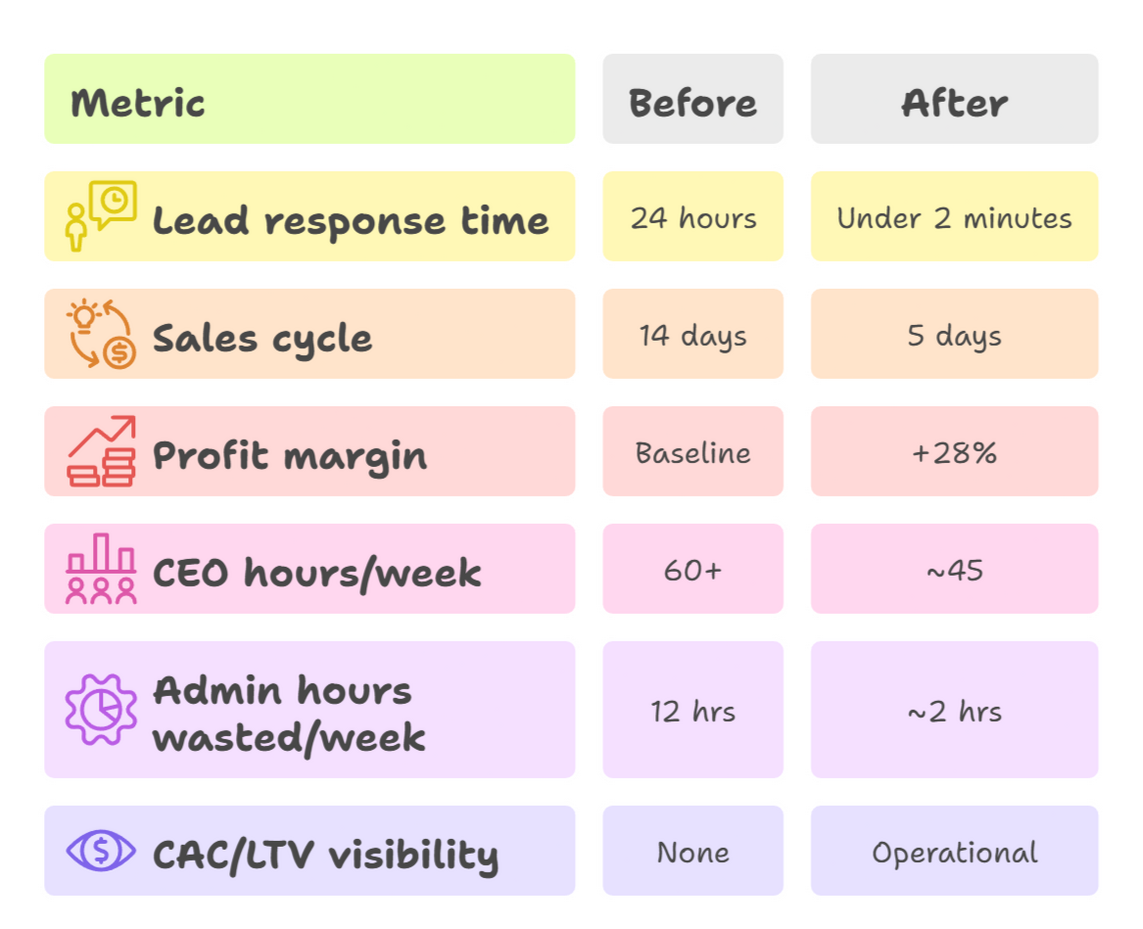
Automated lead intake reduced response time from 24 hours to under 2 minutes. The 4-step manual process was collapsed into a single intake flow. Prospect drop-off at the top of the funnel dropped immediately.
Phase 2 — Capacity Recovery
Internal workflow restructured to remove the CEO from operational decisions that didn't require them. Freed 15 hours per week for high-leverage strategic work.
Phase 3 — Measurement Infrastructure
Built a simple CAC/LTV tracking model that the team could operate without a data analyst. For the first time, the business could see which acquisition channels were actually profitable.
Only after all three were fixed did we enter the Clean Scale phase.
What changed with numbers
This wasn't a marketing problem
The instinct to scale ads was logical. More leads should mean more revenue.
But leads without a functional conversion and delivery system don't become revenue, they become wasted spend and founder burnout.
The diagnostic took 15 minutes. The intervention took 90 days. The result was a business that could finally absorb growth without breaking the person running it.
The question isn't whether you should scale. It's whether your system is ready to.
Is your business ready to grow, or just ready to spend more?
Before your next marketing investment, run a PDM7 diagnostic. 15 minutes. few questions. We'll tell you exactly where your operational leak is.
Stay Connected with PDM7
Follow PDM7 on social media platforms to keep up with the latest insights, tips, and success stories from our business growth agency.
PDM7 encourages continuous learning and recommends the following resources: